
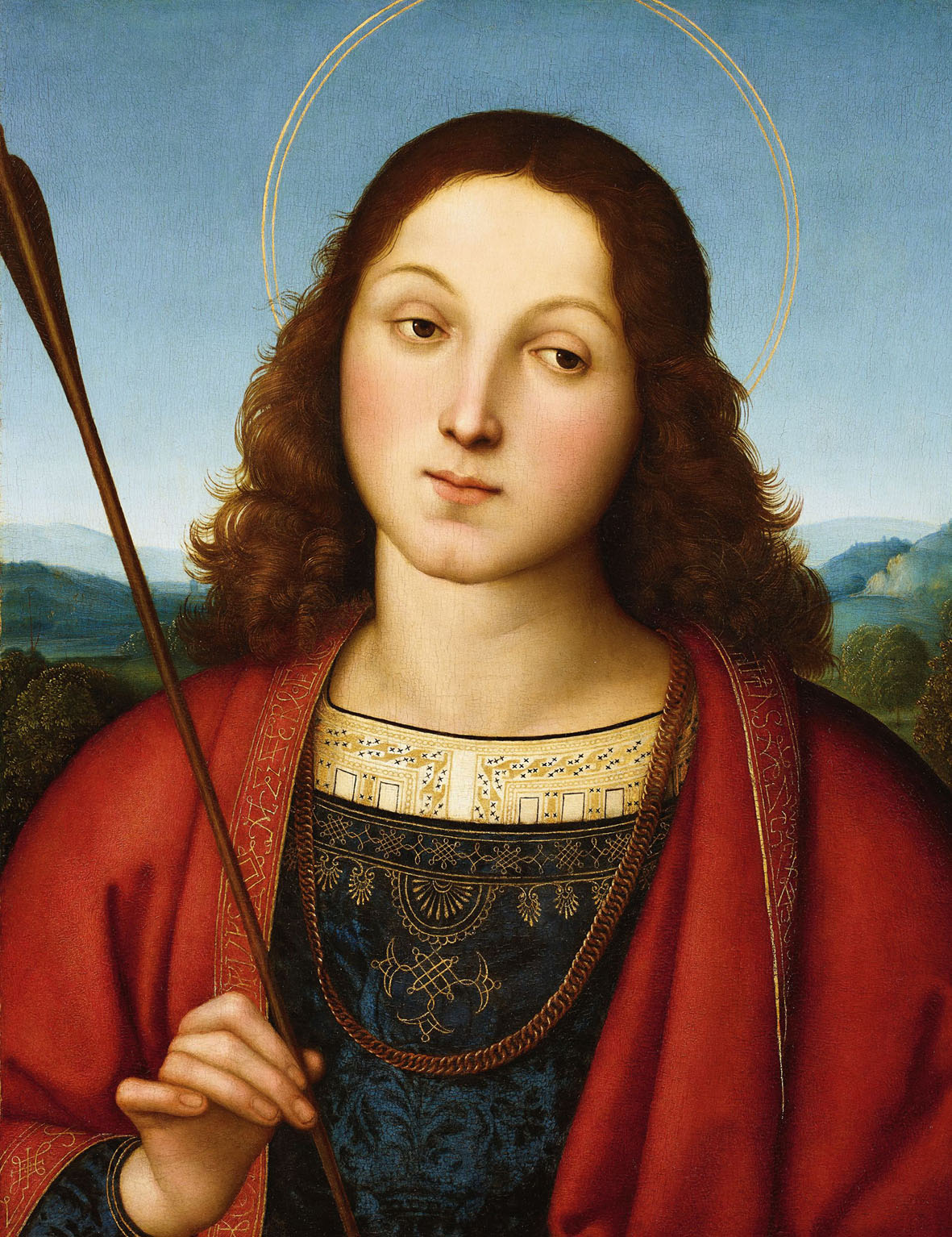
Raphael was a central figure of the High Renaissance whose work defined the visual language of Western art through harmony and balance. His masterpieces, including The School of Athens and various Madonna paintings, established enduring standards for composition, beauty, and the visual representation of intellectual and divine ideals.
By perfecting techniques such as triangular arrangements and atmospheric perspective, Raphael influenced centuries of artistic theory. His structured approach became the foundation for academic art, guiding later movements from the Baroque era to Neoclassicism. His legacy rests on the seamless integration of clarity, proportion, and emotional warmth.

Presumed self-portrait
Born Raffaello Santi (or Sanzio)
1483-1520
Few artists in history have shaped the visual language of Western art as profoundly as Raffaello Sanzio da Urbino, known simply as Raphael. Born in 1483 and gone by 1520 at just 37 years old, Raphael’s career was astonishingly brief—yet his impact reverberates through centuries of painting, architecture, and art theory. If Leonardo da Vinci embodied innovation and Michelangelo embodied raw, muscular intensity, Raphael embodied harmony. His work became the blueprint for beauty, balance, and clarity in Western art.
The School of Athens: A Blueprint for Intellectual Beauty
Raphael’s most famous work, The School of Athens, is more than a fresco—it’s a declaration of what knowledge looks like when expressed visually.
- Philosophers gather in a grand architectural space, symbolizing the unity of reason and faith.
- Plato and Aristotle stand at the center, embodying the balance between idealism and empiricism.
- Every figure is placed with intention, creating a composition that feels both dynamic and serene.
This painting became the gold standard for academic art. For centuries, artists studied its structure to understand how to organize complex scenes without losing clarity.

Raphael: The School of Athens
Medium: Fresco
Date: 1509–1511
What is Fresco? A painting technique where water-based pigments are applied directly onto freshly laid wet plaster, making the artwork an integral part of the wall.
Master of Composition
Raphael’s greatest technical contribution was his mastery of composition. He perfected the use of:
- Triangular arrangements that guide the eye naturally
- Soft, atmospheric perspective that creates depth without drama
- Graceful gestures that communicate emotion without exaggeration
His Madonnas—especially The Sistine Madonna and Madonna of the Meadow—became templates for religious imagery. The balance of motherly tenderness, divine symbolism, and idealized beauty influenced countless painters from the 16th century onward.
Raphael: Sistine Madonna
Medium: Oil on canvas
Date: 1513–1514


Raphael: Madonna del Prato (Madonna of the Meadow)
Medium: Oil on board
Date: 1506
Raphael’s Influence on Later Art Movements
Artists like Caravaggio, Annibale Carracci, and Guido Reni studied Raphael’s clarity and emotional accessibility. Even when Baroque art became more dramatic, Raphael’s sense of order remained a foundation.
In the 18th century, Raphael became the ultimate model for artists seeking purity and restraint. Jacques-Louis David and Ingres revered him, treating his work as the pinnacle of classical perfection.
For centuries, art academies across Europe taught Raphael’s principles as the “correct” way to paint. His compositions were copied, dissected, and used as exercises for students learning proportion, anatomy, and narrative structure.
Watch the video to learn more about his history and art.
Final Thoughts
Raphael’s influence on the art world comes down to one powerful idea: he perfected harmony. In an era filled with artistic giants, he distinguished himself by blending clarity, balance, and emotional warmth into a visual language that became the foundation of Western art. His compositions shaped centuries of painters, his Vatican frescoes defined Renaissance humanism, and his calm, structured approach became the model for academic art long after his death. Even modern artists who broke every rule still acknowledged the brilliance of the rules Raphael created. His legacy endures because he showed that beauty isn’t just what you paint—it’s how everything fits together.
Share your thoughts & leave and leave a comment!