
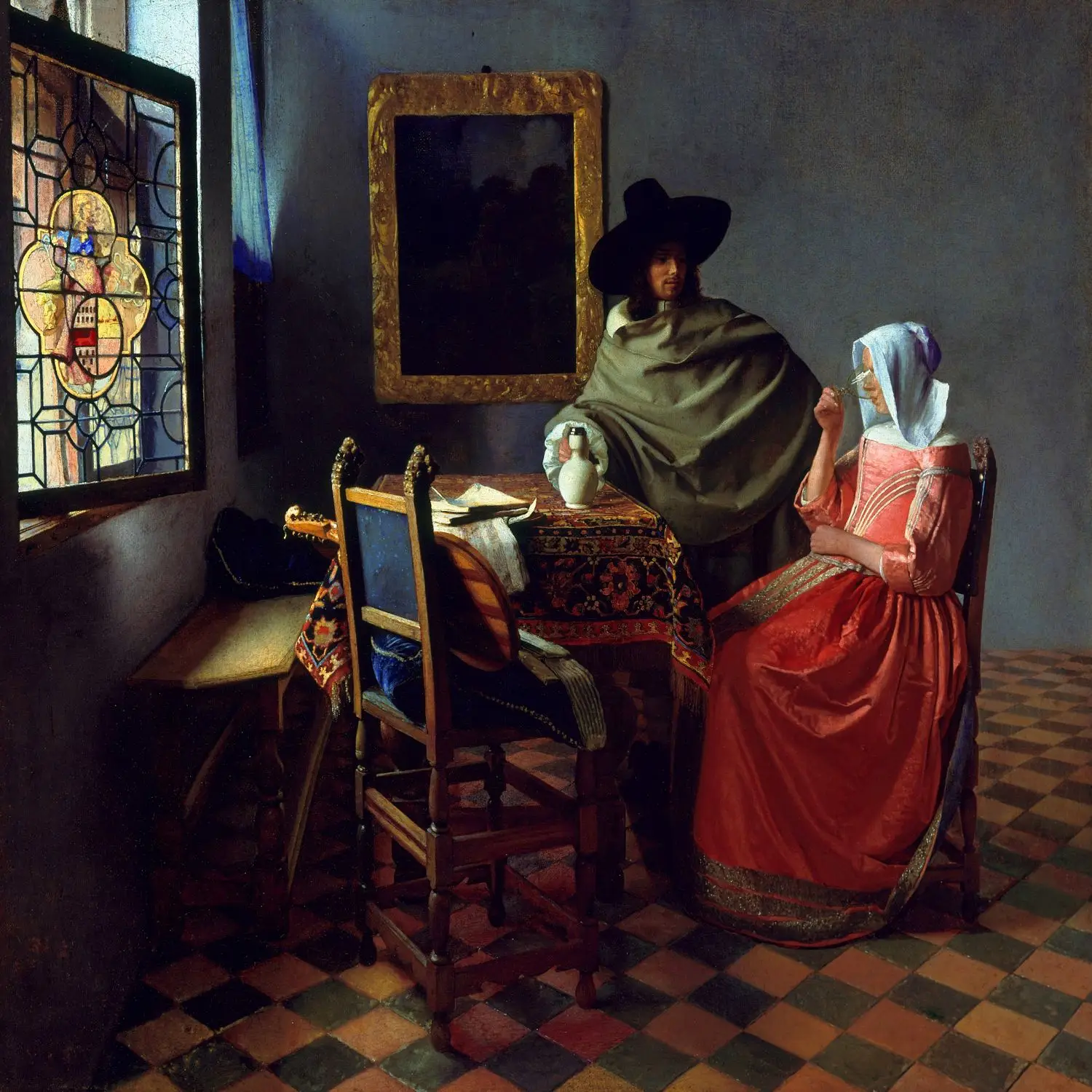
Johannes Vermeer was a 17th-century Dutch Golden Age painter known for his luminous domestic interior scenes. Despite producing a small body of around 36 surviving paintings, he created meticulously crafted compositions using realistic light and high-quality pigments to depict serene, everyday moments.
Vermeer lived a modest life in Delft and died in debt, slipping into obscurity after his death. Nineteenth-century art historians revived interest in his work, establishing his global legacy as a master of naturalistic light and quiet, atmospheric drama.

Johannes Vermeer (1632–1675) stands as one of the most revered painters of the Dutch Golden Age, celebrated for his extraordinary ability to transform ordinary domestic moments into scenes of poetic stillness and radiant beauty. Though only about 34–36 paintings are attributed to him today, each one is a meticulously crafted jewel that showcases his unmatched command of light, color, and atmosphere.
Early Life in Delft
Vermeer was born and baptized in Delft, a thriving 17th‑century city known for its bustling markets, Delftware ceramics, and strong artistic traditions. His father, Reynier Jansz, worked as both a silk weaver and an art dealer—roles that likely shaped Vermeer’s early exposure to painting. By 1652, Vermeer had joined the Guild of St. Luke, establishing himself as a professional painter.

Despite Delft’s prosperity, Vermeer’s own life was modest. He produced few paintings each year and relied partly on art dealing to support his large family. At his death, his wife Catharina Bolnes was left in debt, a stark contrast to the immense value his works hold today.
A Small but Exquisite Oeuvre
Vermeer’s surviving body of work is surprisingly small—around 36 paintings—yet each piece is a masterclass in composition and technique. He worked slowly and used expensive pigments, including ultramarine made from lapis lazuli, which contributed to the luminous blues seen in works like Girl with a Pearl Earring and Woman in Blue Reading a Letter.

Title: Girl with a Pearl Earring
Medium: Oil on canvas
Date: 1665
Title: Woman in Blue Reading a Letter
Medium: Oil on canvas
Date: 1663

His paintings typically depict quiet interior scenes, often featuring solitary women engaged in everyday tasks: reading letters, pouring milk, playing music, or adorning themselves. These moments, though simple, are elevated through Vermeer’s ability to capture inner harmony and emotional stillness.
The Master of Light
Vermeer’s signature lies in his radiant, naturalistic light. He arranged objects—chairs, maps, windows, tables—with mathematical precision, using perspective to create a sense of order and serenity. Light glides across surfaces, softens fabrics, and reveals textures with astonishing clarity.
This mastery is especially evident in works such as:
- The Milkmaid – A humble kitchen scene transformed into a glowing study of color and texture.
- Girl with a Pearl Earring – His most iconic painting, often called the “Mona Lisa of the North.”
- View of Delft – A rare cityscape capturing the quiet grandeur of his hometown.
- The Art of Painting – An allegorical masterpiece celebrating the craft itself.

Title: The Milkmaid
Medium: Oil on canvas
Date: 1660
Title: View of Delft
Medium: Oil on canvas
Date: 1659-1661


Rediscovery and Legacy
During his lifetime, Vermeer was respected locally but not widely known. After his death, he slipped into obscurity for nearly two centuries. It wasn’t until the 19th century that art historians Théophile Thoré‑Bürger and Gustav Friedrich Waagen rediscovered his work, sparking the global admiration he enjoys today.
Today, Vermeer is celebrated as a master of quiet drama, a painter who found profound beauty in the everyday. His influence extends into modern photography, film, and even contemporary painting—anywhere artists seek to capture the subtle interplay of light and human presence.
Share your thoughts & leave and leave a comment!