
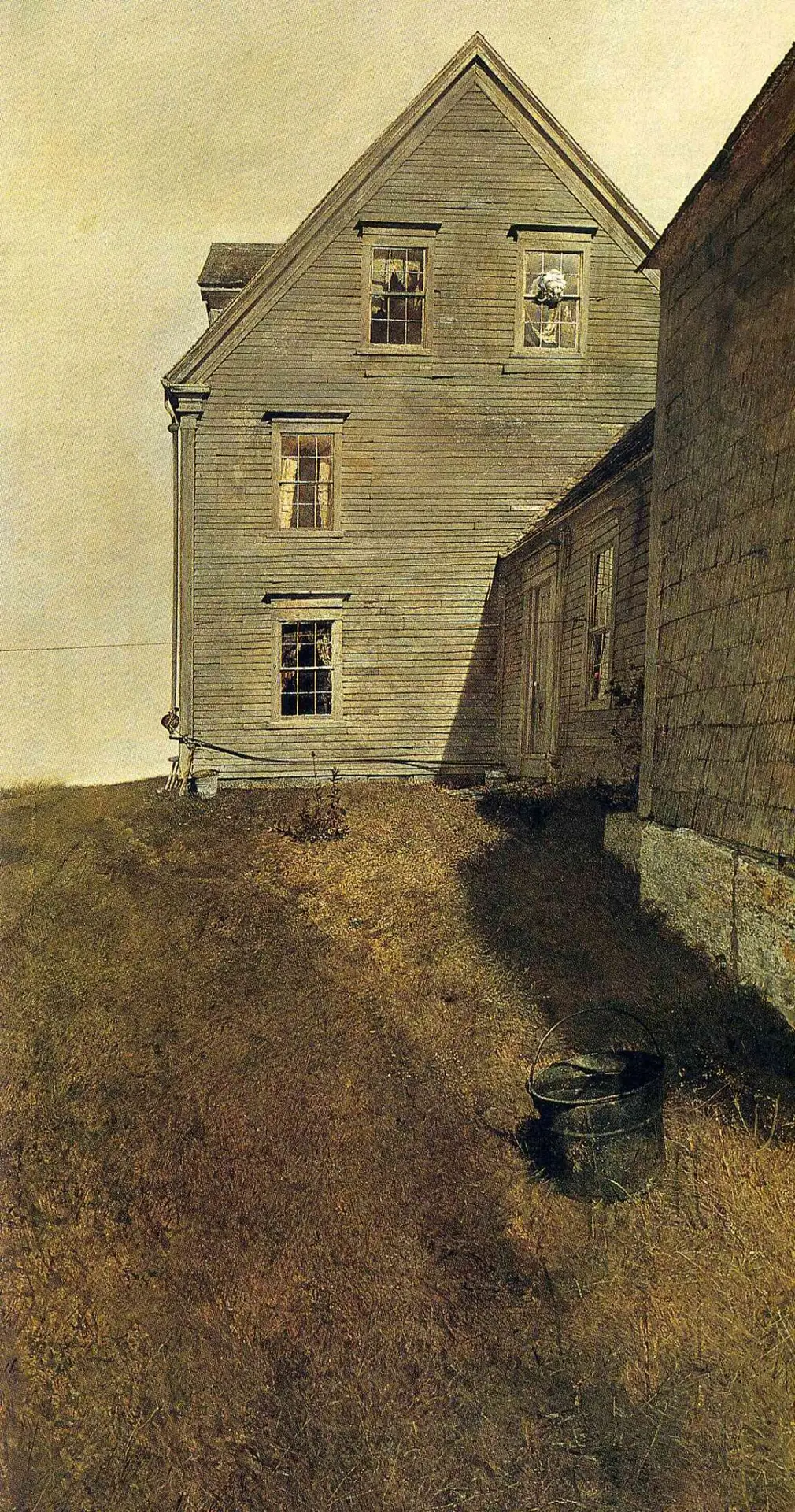
Andrew Wyeth was a prominent 20th-century American realist known for his atmospheric and psychological approach to painting. His work utilizes muted palettes to depict stark landscapes, intimate interiors, and isolated figures. By focusing on textures and subtle light, Wyeth emphasizes emotional resonance over photographic accuracy.
Wyeth’s compositions elevate everyday objects into symbolic anchors, inviting viewers to find meaning in stillness. His art serves as a quiet rebellion against spectacle, capturing the honest truths of solitude and memory. This enduring style continues to influence contemporary artists exploring interior storytelling and the poetry of the mundane.

Wyeth remains one of the most quietly influential American realists of the 20th century. His paintings are not loud, not flashy, and not designed to overwhelm the viewer. Instead, Wyeth’s work pulls you into a world of muted colors, stark landscapes, and intimate interiors where emotion lives in the silence between objects. His realism is not about accuracy — it’s about atmosphere.
Wyeth’s paintings feel like memories you’ve never had but somehow recognize. They carry the weight of solitude, the tension of stillness, and the haunting beauty of everyday spaces. In a time when art often leaned toward abstraction or bold experimentation, Wyeth stayed committed to the quiet drama of realism, proving that subtlety can be just as powerful as spectacle.
A Realism Built on Atmosphere
Wyeth’s realism is not photographic. It’s psychological. He used limited palettes — browns, grays, ochres, pale greens — to create a world that feels suspended in time. His brushwork is delicate but intentional, capturing textures like weathered wood, worn fabric, and cold winter light with uncanny sensitivity.
What makes his realism unique is the emotional charge beneath the surface. A Wyeth interior is never just a room. A Wyeth landscape is never just a field. Every object feels like it has a story, and every shadow feels like it’s hiding one.
Interiors That Hold Their Breath
Wyeth’s interior scenes are especially compelling. They often feature: sparse furniture; windows with pale, diffused light; worn floors and textured walls; personal objects arranged with symbolic weight. These spaces feel lived-in but lonely, familiar yet distant. The idea that a room can be a character, a memory, or a psychological landscape.

Title: Master Bedroom
Medium: Tempera on panel
Date: 1965
Wyeth understood that interiors are emotional environments. His rooms are quiet, but never empty.
Figures in Isolation
Wyeth’s portraits and figure paintings often depict people in moments of introspection or solitude. His most famous subject, Christina Olson, appears in multiple works, each one revealing a different facet of her life and physical limitations.

Title: Christina’s World
Medium: Tempera on panel
Date: 1948
Wyeth didn’t romanticize his subjects. He painted them with honesty — sometimes harsh, sometimes tender, always human. His figures feel like they exist in the same emotional world as his interiors: quiet, resilient, and deeply personal.
The Poetry of Everyday Objects
One of Wyeth’s greatest strengths is his ability to elevate ordinary objects into symbols. A bucket, a doorframe, a bed, a coat — these items become emotional anchors within the composition. This is where his realism becomes storytelling.
Wyeth believed that the smallest details could carry the most meaning. His paintings invite viewers to slow down, look closely, and find significance in the mundane. It’s a philosophy that resonates strongly with artists who work in interior genres, where atmosphere is built from subtle choices.
What is Tempera? A fast‑drying paint made by mixing pigment with an egg‑based binder, usually egg yolk.
Why Wyeth Still Matters
In a world saturated with fast images and digital noise, Wyeth’s work reminds us of stillness’s power. His realism counters spectacle—a quiet rebellion against the idea that art must be loud to be impactful. Wyeth’s paintings endure because they feel honest.
They capture the emotional truth of solitude, memory, and the spaces we inhabit. His work continues to influence contemporary artists who explore atmosphere, interior storytelling, and the poetry of everyday life.
Conclusion
Andrew Wyeth’s realism is not about perfect representation — it’s about emotional resonance. His muted palettes, atmospheric interiors, and intimate storytelling make him one of the most compelling artists to explore within the realism genre. For artists and viewers alike, Wyeth offers a reminder: the quietest scenes often speak the loudest.
View more of his work:
Share your thoughts & leave and leave a comment!