
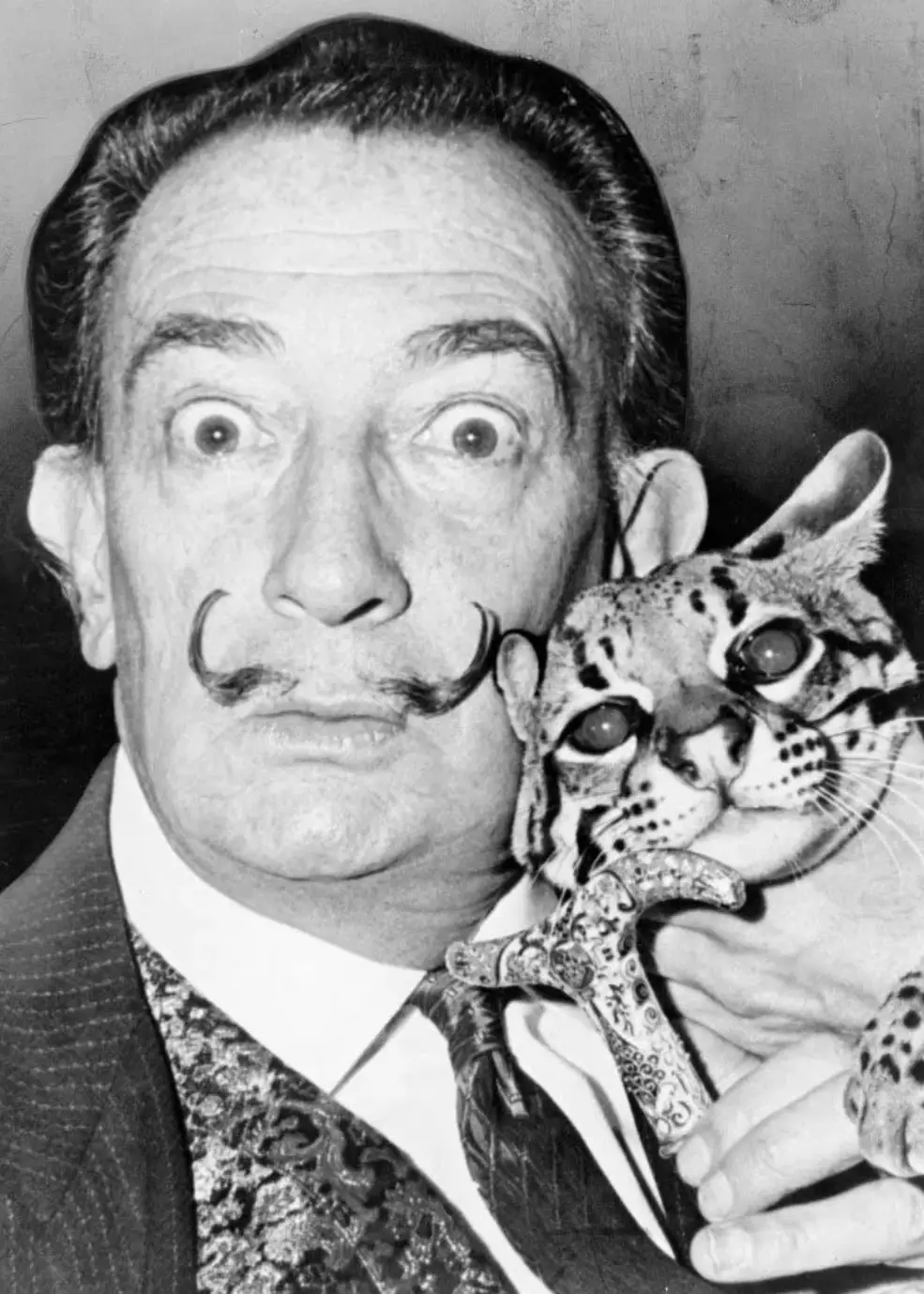
Salvador Dalí was a Spanish artist and a leading figure of the Surrealist movement. His work utilized technical precision to depict dreamlike imagery and psychological themes. He gained international fame with his 1931 painting The Persistence of Memory and collaborated on pioneering Surrealist films during his early career.
After residing in the United States, Dalí returned to Spain and explored nuclear mysticism, blending religious themes with scientific theory. He established his own museum in Figueres before he died in 1989. His extensive body of work continues to influence contemporary art, film, and popular culture globally.

Salvador Dalí (1904–1989) remains one of the most recognizable and influential artists of the 20th century — a painter whose dreamlike visions, melting clocks, and eccentric persona helped define Surrealism for the modern world. His work blends technical mastery with psychological depth, pulling imagery from dreams, memory, religion, science, and the subconscious. Dalí didn’t just paint Surrealism; he performed it, lived it, and transformed it into a global cultural force.
Early Life & Artistic Formation
Dalí was born in Figueres, Catalonia, Spain, into a bourgeois family that encouraged his creativity. Summers spent in Cadaqués shaped his early love of landscape and light. He studied at the San Fernando Academy of Fine Arts in Madrid, where he absorbed a wide range of styles — Impressionism, Cubism, and classical Renaissance techniques — and befriended influential figures like Federico García Lorca and Luis Buñuel.
His first solo exhibition took place in Barcelona in 1925, and by 1928, his work appeared in the Carnegie International Exhibition, marking his international debut.
Surrealism & Breakthrough Works
Dalí officially joined the Surrealist movement in 1929, quickly becoming one of its most prominent voices. His paintings explored subconscious imagery, dreams, sexuality, and psychological tension — often rendered with razor‑sharp realism.
The Persistence of Memory (1931)
This iconic painting, featuring limp melting watches draped across a barren landscape, became the visual symbol of Surrealism worldwide. Dalí completed it in August 1931, and it remains his most famous work.
Other major works include:
- Soft Construction with Boiled Beans (Premonition of Civil War) (1936)
- Dream Caused by the Flight of a Bee Around a Pomegranate a Second Before Awakening (1944)
- Christ of Saint John of the Cross (1951)
- Galatea of the Spheres (1952)
- Crucifixion (Corpus Hypercubus) (1954)
- The Hallucinogenic Toreador (1970)

Title: Soft Construction with Boiled Beans (Premonition of Civil War)
Medium: Oil on canvas
Date: 1936
Title: Dream Caused by the Flight of a Bee Around a Pomegranate a Second Before Awakening
Medium: Oil on wood
Date: 1944


Title: Christ of Saint John of the Cross
Medium: Oil on canvas
Date: 1951
Title: Galatea of the Spheres
Medium: Oil on canvas
Date: 1952


Title: Crucifixion (Corpus Hypercubus)
Medium: Oil on canvas
Date: 1954
Title: The Hallucinogenic Toreador
Medium: Oil on canvas
Date: 1970

Dalí also collaborated with Buñuel on groundbreaking Surrealist films such as Un Chien Andalou (1929) and L’Âge d’Or (1930).
Exile, Fame, and the Classical Period
During the Spanish Civil War, Dalí lived in France, then fled to the United States in 1940, where he achieved major commercial success. The Museum of Modern Art (MoMA) held a major retrospective of his work in 1941, solidifying his international reputation.
After returning to Spain in 1948, Dalí entered his “nuclear mysticism” period — blending religion, classical art, and scientific ideas such as atomic theory. This era produced monumental works like:
- The Discovery of America by Christopher Columbus
- The Sacrament of the Last Supper
- The Hallucinogenic Toreador
Later Life & Legacy
Dalí opened the Teatro-Museo Dalí in Figueres in 1974, a sprawling, immersive museum dedicated to his life and work.
His later years were marked by illness, especially after the death of his wife and muse Gala in 1982. Dalí died in 1989 in his hometown of Figueres.
Today, Dalí’s influence extends far beyond painting — shaping film, fashion, advertising, pop culture, and contemporary art. His blend of technical precision and surreal imagination continues to inspire artists worldwide.
Why Dalí Still Matters
Dalí’s work remains compelling because it merges dream logic with flawless technique. He showed that realism could be a gateway to the subconscious, and that art could be both technically brilliant and psychologically daring. His imagery — melting clocks, elongated shadows, impossible landscapes — has become part of our cultural vocabulary.
Dalí didn’t just change art; he changed how we imagine.
Share your thoughts & leave and leave a comment!