
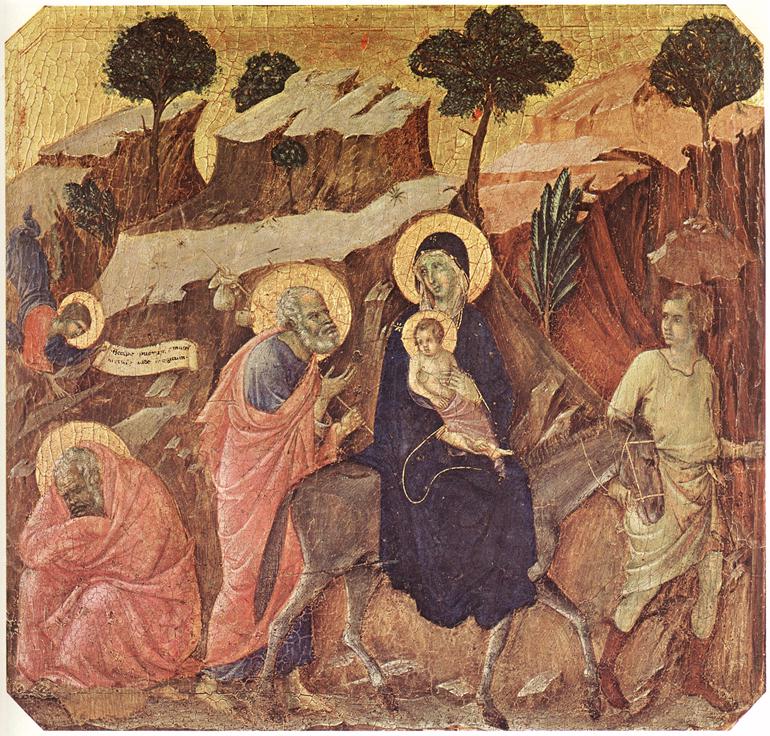

Duccio di Buoninsegna (c. 1255/1260–1318/1319) stands as one of the most influential painters of the Middle Ages, a visionary whose work helped define the Sienese School and shape the transition from Byzantine formality to Gothic emotionality. His art is lyrical, spiritual, and deeply human—qualities that set him apart from his Florentine contemporaries and gave Siena its own artistic identity.
Early Life in Siena
Duccio was born in Siena, where he lived and worked for nearly his entire life. Although many details of his early years remain uncertain, archival records paint a vivid picture of a talented but somewhat unruly citizen. He was fined multiple times—sometimes for debts, sometimes for unspecified misconduct—suggesting a restless temperament and difficulty managing finances.
Despite these troubles, Duccio’s artistic gifts were undeniable. By 1278, he was already recognized as a painter and commissioned to decorate twelve document coffers for the Commune of Siena. This early work shows he was not an apprentice but an established artist trusted with civic projects.
A Style Between Worlds
Duccio’s art is often described as a fusion of Italo‑Byzantine tradition and emerging Gothic sensibilities. His paintings retain the solemnity and gold‑ground splendor of Byzantine icons, yet they introduce:
- softer modeling of faces
- tender emotional exchanges
- elegant, calligraphic drapery
- architectural settings that hint at three‑dimensional space
These innovations helped humanize sacred figures, making them more approachable and expressive. His work marks a turning point in Western art, bridging medieval symbolism with the early stirrings of Renaissance realism.
Major Works

Commissioned for Santa Maria Novella in Florence, the Rucellai Madonna is one of Duccio’s earliest documented masterpieces. It shows the Virgin enthroned, surrounded by angels, painted with a lyrical softness that distinguishes Duccio from Cimabue, the Florentine master he may have worked alongside.

Duccio’s crowning achievement is the monumental Maestà, created for the high altar of Siena Cathedral. This enormous double‑sided altarpiece was carried in a grand procession through the streets of Siena upon completion—a testament to Duccio’s fame and the civic pride invested in his work.
The Maestà includes:
- a majestic front panel of the Virgin and Child surrounded by saints and angels
- intricate narrative scenes from the lives of Christ and the Virgin
- refined Gothic ornamentation
- expressive storytelling that breaks from rigid Byzantine conventions
Many smaller panels from the predella and reverse side are now dispersed across museums worldwide.
A Life of Contrasts
Duccio’s biography is filled with contradictions:
- Celebrated artist, yet frequently fined for debts and civic offenses.
- Deeply spiritual painter, yet once fined for an accusation related to sorcery (likely minor or symbolic).
- Master of Siena, yet overshadowed in later centuries by Giotto, the Florentine innovator.
These tensions make Duccio a compelling figure—an artist whose personal struggles never dimmed the brilliance of his work.
Share your thoughts & leave and leave a comment!